----
An illustrated history of the iPod and its massive impact
// Cult of Mac

Editor's note: The iPod has enjoyed a good long run as one of the world's most revolutionary music machines, but the time has come to bid adieu to the click-wheeled wonder.
Apple quietly removed the iPod Classic from its website this week, so now is the perfect time to wax nostalgic. Cult of Mac is republishing this illustrated history of the iPod — put together to celebrate the device's 10th anniversary, and originally published on Oct. 22, 2011 — to mark this solemn occasion.
An Illustrated History of the iPod


Rubinstein spent a few weeks on the project but concluded the technology wasn't yet there. Either it would be big and bulky, or the battery would suck, or it would have limited memory. He was just about to give up when he made a routine visit to Toshiba, one of Apple's hard drive suppliers. At the end of a meeting, the Toshiba executives offhandly showed him a new, 1.8-inch hard drive they had just prototyped. They didn't know what to do with it. Rubinstein immediately recognized it as the key technology for the first iPod.

Rubinstein recruited engineer Tony Fadell to oversee the hardware. In less than nine months, Fadell's team had a product ready to go. Apple's marketing guru Phil Schiller suggested the scroll wheel because it was clear early on that users will have to navigate huge lists of songs. To speed things up, the iPod was assembled from off the shelf parts — a Toshiba hard drive, a Sony battery and chips from Texas Instruments.

The name "iPod" came from a freelance copywriter, Vinnie Chieco, who as soon as he saw the pure white device thought of Stanley Kubrik's 2001 and the immortal line: "Open the Pod Bay doors, Hal." Steve Jobs was talking a lot about the iMac and iLife, so adding the "i" prefix was a natural thing to do. Jobs initially rejected the iPod name, but later came around to it.


iPod cutaway by Silvan Linn
2000
January 9: Apple releases its iTunes music jukebox software, which was based on a program called SoundJam MP, purchased by Apple in early 2000. Some critics complain that it doesn't have a boatload of advanced features, but it is nice, simple and makes digital music easy.

Screenshot: Graphical User Interface Guidebook
October 23: Only a month after 9/11, and in the midst of an anthrax terrorist scare, Jobs took the stage at Apple's HQ to announce the first iPod. From the get-go, he has large ambitions for the device. He calls it a "breakthrough digital device."

"Music is a part of everyone's life," he said, "and because it's a part of everyone's life, it's a very large target market all around the world. It knows no boundaries."
The small white player has a 1,000 song capacity thanks to its 5GB hard drive, but costs $399.
Watch Jobs unveil the iPod:
The initial reaction from the public is not good. Most critics think it's too expensive and does too little. "All that hype for an MP3 player? Break-thru digital device?" said one commentor on MacRumors forums. "The Reality Distiortion Field™ is starting to warp Steve's mind if he thinks for one second that this thing is gonna take off."
Others riff on the name iPod: "Idiots Price Our Devices"; "I prefer Owning Disks"; "I Prefer Other Devices."
2002

July 17: The second-generation iPod is released in 10- and 20GB capacities. Similar in appearance to the previous generation, this version featured a touch-sensitive wheel instead of the prior mechanical one. It also had a redesigned hold switch and a cover on the FireWire port. The iPod was now Windows-compatible as well, thanks to Musicmatch software.

September: In France, the iPod was briefly taken off the market when authorities said it was too loud and could damage listeners' ears. Under French law, portable devices were limited to 100 decibels. The iPod's software was quickly updated to reduce the volume. Users in other European countries are not happy.
October: With the release of iTunes 4.1 comes compatibility with Windows 2000 and XP; iPod sales explode following this development. Jobs gets his friends in the music business, including U2′s Bono and Mick Jagger, to help launch the software. Apple takes out cheeky ads that say "Hell Froze Over."

December: Apple offers limited-edition iPods with signatures of Madonna, Tony Hawk, Beck, or No Doubt laser-engraved on the back. These are the most expensive iPods Apple has sold: the top-of-the-line model cost $548.

Number of iPods sold through 2002: 600,000
2003
April 28: Apple releases the third-generation iPod, which moves the control buttons to a new row of touch-sensitive buttons under the screen. This model introduces the USB dock connector for syncing. Apple also introduces iTunes Music Store, which opens with 200,000 songs available for 99 cents each. At a time when music piracy is rampant, the move is seen as ballsy. Who would pay for music when it is available for free? But Jobs argued that simplicity and ease of use would trump stealing. Most consumers wanted to do the right thing, he said.

The 3G iPod marks the most important change in the iPod's early history: Apple adds USB alongside FireWire. This makes the iPod compatible with vast numbers of Windows PCs, and sales start to explode.
May: Oprah names the iPod one of her "Favorite Things" and gives everyone in her show's 350-member live audience a 15GB iPod worth $399.

June: One millionth iPod sold.
Summer: The iconic silhouette ads become ubiquitous. The white earbuds turned out to be a marketing masterstroke: They advertised a player that was hidden away in a bag or pocket. They were just a lucky accident. Apple's head designer, Jony Ive, said the headphones are white because the iPod was white. But Apple soon realized its good fortune, emphasizing the white earbuds in its iconic silhouette ads.
September: iTunes downloads top 10 million songs.
September: Apple Corps, which holds the rights to The Beatles' catalog, sues Apple for violating a trademark agreement. Apple Computer had agreed to stay out of the music business, but with 10 million songs sold in iTunes, it was becoming unambiguously involved. When the case came before the High Court in London, the judge considered disqualifying himself because he used an iPod. Apple's lawyers argued that not even "a moron in a hurry" would mistake the two companies. The case was settled in 2007 — in favor of the computer company.
October: Apple makes the iTunes Music Store available to Windows users.
October: Dell launches its Digital Jukebox (DJ), which is heralded as the "iPod killer" because of its lower price point.
November: The anti-iPod backlash reaches a crescendo with "iPod's Dirty Little Secret," a video by the Neistat brothers complaining about the iPod's battery. The video goes viral and Apple starts a cheap battery replacement program.
Watch "iPod's Dirty Little Secret."
December: iTunes song downloads top 25 million.
December: Canadian authorities dragged the iPod into controversy about music piracy when it levied a CDN$25 charge on every iPod to compensate artists whose music was being ripped off.
Number of iPods sold through 2003: 2 million
2004
January 6: Apple goes small with the "iPod mini." The mini is released with 4GB of storage and in 5 colors. It features a new "click wheel" which combines the control buttons integrated into a solid-state, touch-sensitive scroll wheel.

February 1: Apple and Pepsi launch the biggest iTunes promotion yet. Publicized with splashy Super Bowl commercials, the two companies promise to give away 100 million free songs through iTunes.
February: Random shuffle inspires laudatory essays in cultural organs like The New Yorker, Wired and The Guardian. Professor Michael Bull says Shuffle is the signature feature of digital music, turning the iPod into an "Alladin's Cave of aural surprises."

March: After a string of muggings and robberies, the West Midlands Police, one of the largest police forces in the U.K., warned iPod users to stop using white earbuds.
June: BMW debuts the first car entertainment system with built-in iPod integration. Within a couple of hers, 90% of new cars would also offer this feature.
June: In a big cover story, Newsweek declares that America is "iPod Nation."

July: iTunes downloads top 100 million songs. The person who purchased the 100 millionth song, Kevin Britten of Hays, Kansas, gets a congratulatory phone call from Steve Jobs.
July 19: The fourth-generation iPod is released, with the new click wheel controls from the iPod mini. Available in 20GB and 40GB capacities.


August: The classic first-person-shooter Doom, which geeks have tweaked to run on almost every computing device known to man, is finally ported to iPod. It's a sign the iPod had finally gained nerd cred.
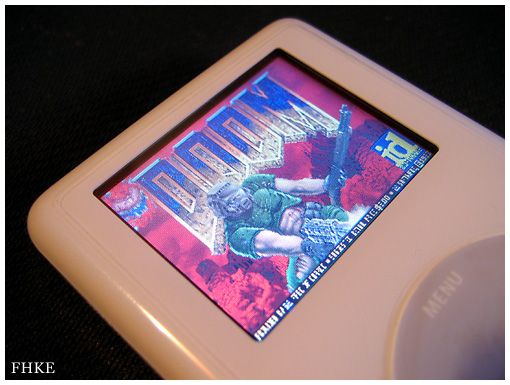
Doom runs on iPod. Photo: FHKE/Flickr CC
October: Microsoft CEO Steve Ballmer calls iPod users music thieves because "the most common format of music on an iPod is 'stolen'." He soon apologizes.
October 26: Apple introduces "iPod Photo" as its premium iPod featuring a color screen and updated UI for viewing pictures. Apple also releases the "iPod U2 Special Edition," a 30GB fourth-generation model with an all-black enclosure and red click wheel. On the back, the signatures of U2′s members are laser engraved and several exclusive U2 videos are included on the iPod's hard drive.

December: Playboy launches iBod, a set of saucy pictures optimized for the iPod photo. The galleries of PlayMates, Blondes and Voluptuous Vixens are dubbed the first 'iPod porn.'

Number of iPods sold through 2004: 10 million
2005
January 11: Apple announces a new entry-level iPod, the iPod shuffle, using flash memory with 512MB and 1GB capacities. Plugs directly into computer through onboard USB.

February 22: The second-generation iPod mini is released with updated colors and a longer battery life.
September: Apple rolls out a bunch of new iPod games through the iTunes Store.

September 7: Steve Jobs shocks the gadget word when he kills off the very successful iPod mini in favor of the iPod nano. The nano includes a color screen for photo viewing and is available in black or white, with 2GB and 4GB capacities. Later, a cheaper 1GB version is added to the line. Initially, Jobs' move was judged as reckless and crazy. Later, it was seen as pure Apple: Jobs was his own fiercest competitor.

October 12: The fifth-generation iPod is released, featuring another complete redesign. The new look brings a slimmer profile and larger screen for playing videos. Made available in black and white.

December: The White House reveals that even President George Bush has an iPod. Here he is discussing his playlist:
Number of iPods sold through 2005: 42 million
2006
February: iTunes sells its one billionth song.
Summer: iPod-inspired cakes reach a tipping point on the Web.

iPod cakes are all the rage. Photo: Paul Gault/Flickr CC
Fall: Everyone and their kids dresses as an iPod for Halloween.
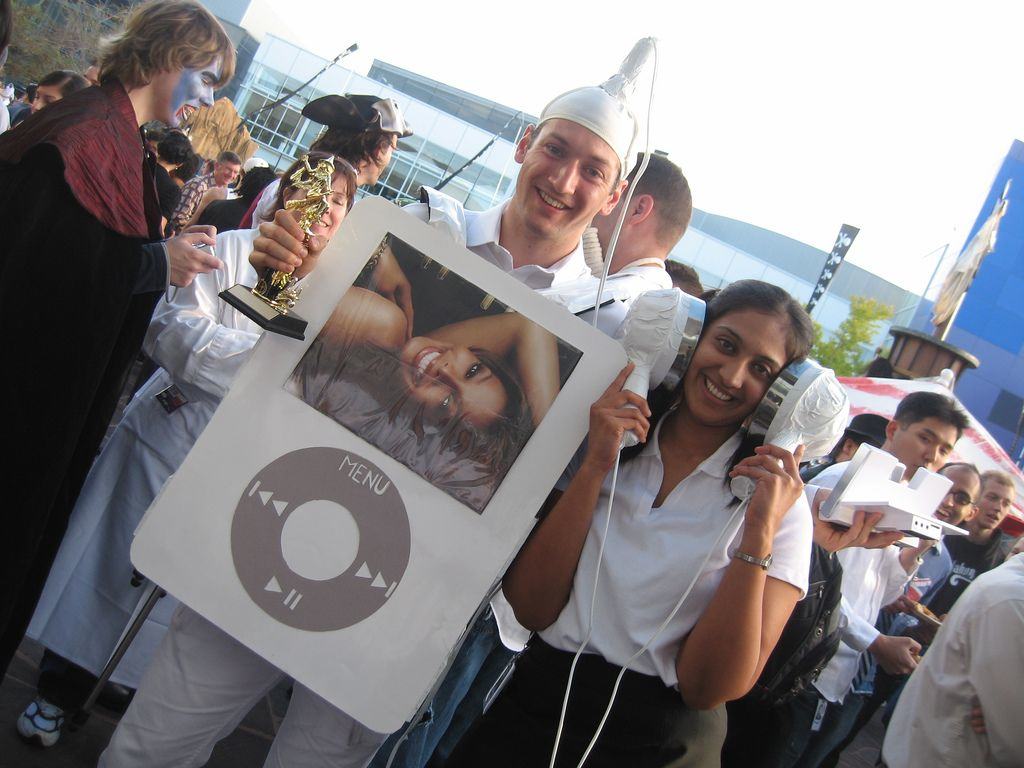
Dressing up as an iPod becomes a Halloween sensation. Photo: Maria Ly/Flickr CC
September 12: The second-generation iPod nano is unveiled, featuring an anodized aluminum casing available in six colors, a design that hearkened back to the iPod mini. Alongside the new nano comes the second-generation iPod shuffle, which also gets a new anodized aluminum body, as well as a clip on the back.

The second-generation iPod nano came in multiple colors.
Number of iPods sold through 2006: 88 million
2007
January 9: Steve Jobs delivers the keynote address at the Macworld Conference and announces three new products: "a widescreen iPod with touch controls," a "revolutionary mobile phone" and "a breakthrough Internet communicator." To uproarious applause, he reveals that these three products are actually a single device: the long-awaited and oft-rumored iPhone. Though it won't be released until June, Jobs demonstrates among many other features the built-in iPod media player application, featuring touch-controlled CoverFlow.
Watch Jobs' greatest performance, the introduction of the iPhone.
January: Spoof iPod ad featuring Microsoft CEO Steve Ballmer doing the "Monkey Boy" dance becomes smash viral hit:
April: 100 millionth iPod sold.
June 29: Apple releases the iPhone to long lines of eager shoppers in 4GB and 8GB sizes. After two months, Apple discontinues the 4GB model and drops the price of the 8GB model significantly, upsetting early adopters.

September 5: With the sixth generation of the original iPod comes a new name: "iPod classic." Apple updates the UI again and adds an anodized aluminum front. Available in black or silver in 80GB or 160GB sizes. A year later Apple discontinues both capacities for a single 120GB model. Apple also unveils the third-generation iPod nano, which features a 2-inch, video-ready screen in a nearly square enclosure, and a smaller click wheel. Most importantly, Apple begins the process of making the classic iPod obsolete by introducing a new touch-screen iPod, the iPod touch. It brings the multi-touch, web access, and media player features of the iPhone without the monthly cellular bill. Initially offered in 8GB and 16GB, with 32GB added to the line in February of 2008.

Number of iPods sold through 2007: 141 million
2008
February 5: Apple adds a 16GB model to the iPhone line.
March: The iPod goes to space on the Space Shuttle Endeavor.

April: iTunes passes Walmart to become the top music vendor in the United States.
July 11: Apple releases the iPhone 3G, a new model with a curved plastic back and 3G cellular data capabilities. Available in 8GB and 16G storage capacities.

September 9: Apple releases the fourth-generation iPod nano, reverting back to the original tall form factor and all-aluminum case. An included accelerometer allows for horizontal use. Apple also updates the iPod touch, bringing a curved chrome back, hardware volume controls, and a built-in speaker.

September: iPod connectivity is offered in more than 90% of new cars sold in the U.S.
Number of iPods sold through 2008: 197 million
2009
February: Jobs writes an open letter on Apple.com, Thoughts on Music, announcing that all songs in iTunes are DRM-free. It's a watershed moment for the digital music industry. Instead of fighting customers with restrictive file-protection schemes, Jobs made things easier for the consumer over the rights holders. It's also an acknowledgment that Jobs' iTunes strategy had worked: simplicity and ease of use could compete with piracy.

March 11: The third-generation iPod shuffle is announced, featuring a tiny form factor and no hardware controls at all; all controls have been moved to buttons on the headphone cable. Introduced VoiceOver technology allows the iPod to speak the name of playlists, artists, or tracks that the user selects.

April 1: On a state visit to the U.K, President Barack Obama gives the Queen of England an iPod.

April 27: All songs in the iTunes store become DRM-free as Apple adopts new pricing tiers at 79 and 99 cents and $1.29.
June 19: Apple releases an updated iPhone model, the iPhone 3GS. Nearly identical to its predecessor in appearance, it features upgraded internal components. The "S" stands for "speed."
September: Apple replaces the 120GB iPod classic with the 160GB model.
September 9: With the fifth-generation iPod nano, Apple gives the model a polished outer case and onboard video camera — the first in an iPod. This model also receives a speaker, FM tuner and larger screen, and is offered in 8GB or 16GB sizes. Also announced is the third version of the iPod touch, which brings the iPhone 3GS's upgraded processor and VoiceOver support.


Number of iPods sold through 2009: 250 million
2010
June 21: Apple releases the iPhone 4, featuring a flat, minimalist design and a metal band around the outer edge to serve as antennae. Even before Apple announces it, the iPhone 4 is steeped in controversy after an Apple engineer leaves a prototype test model in a bar and it makes its way to the hands of the tech blog Gizmodo. After the release, users discover that holding the iPhone 4 in "the wrong way" can greatly diminish the cellular signal.

September 1: Multi-touch comes to the iPod nano with the sixth-generation model. In addition, Apple also brings the clip from the iPod shuffle but removes video, speakers, and camera features. A fourth iteration of the iPod shuffle is also released, keeping the previous generation's VoiceOver feature but bringing the media controls down from the headphones and back to the outside of the unit itself.
September: President Obama discusses his 2,000-song iPod playlist with Rolling Stone: Jay-Z dominates but there is also Nas and Lil Wayne. He says, "Music is still a great source of joy and occasional solace in the midst of what can be some difficult days."

September 9: Apple unveils the fourth-generation iPod touch, with an even thinner design and two cameras. One camera on the back captures HD video, while the second camera on the front brings FaceTime video-calling capabilities. Apple also packs in their A4 processor and the Retina Display.
November: After years of rumors, speculation and hope, The Beatles catalog finally comes to iTunes. Still no sign of Led Zeppelin or the Rolling Stones.

Number of iPods sold through September 1, 2010: 275 million
2011
October 4: Apple unveils an updated iPhone model dubbed the iPhone 4S, which features a faster processor and an innovative AI called Siri. The iPod touch also sees a minor upgrade.
These days, the iPod is everywhere. Below, a female warrior of Southern Ethiopia's Mursi tribe holds her AK-47 and iPod.

Photo courtesy iLounge
----
Shared via my feedly reader
Sent from my iPhone


